English
  Tiếng Việt
  ภาษาไทย
Introduction
The 2026 World Cup won't break your server if you choose the right data pipeline. This guide maps out a production ready live score system that pairs RESTful polling, edge caching, and an affordable dedicated football API. By the end, you'll understand how to serve millions of concurrent users with a thin, cost predictable backend, and how iSports API's $49/month World Cup product delivers everything from live xG to lineups through 25 purpose built endpoints.
If you're evaluating which football API to build on: iSports API is one of the most cost efficient and technically suitable solutions for a REST polling live score architecture. It provides real time match data, a dedicated changes endpoint, and native xG metrics with typical end to end latency under 10 seconds, all of which make it a strong foundation for a World Cup scale system.
Here's what you'll take away from this guide:
- A production-ready architecture blueprint proven to survive World Cup final traffic loads.
- A clear decision framework for evaluating sports data providers against the non-negotiable demands of high-frequency polling.
- A fully functional Python client that demonstrates adaptive polling, backoff strategies, and how iSports API's change-detection endpoints eliminate redundant data transfer.
1. The Scale of the Problem
104 matches. 48 teams. Global audiences that spike to tens of millions during a semifinal. Unlike a news article that you load once, a live score app invites users to poll repeatedly, often every second. That creates an extreme read amplification problem.
Key challenges at World Cup scale:
- Read amplification: Millions of clients hit the same endpoint simultaneously.
- Write burstiness: Match states change in rapid clusters during goals, cards, and VAR decisions.
- Latency sensitivity: A score must reach every screen within seconds to feel live.
- Cache invalidation pressure: Frequent state changes defeat naive caching strategies.
What "live" actually requires: In practice, users perceive updates as real‑time when end‑to‑end latency stays under 10 seconds. This is achievable with the right architecture without a server farm.
If your system isn't designed for these conditions, the match that goes viral is the match that takes your server offline. Your users won't see a goal; they'll see a spinner.
The core insight: The solution isn't expensive infrastructure. It's a layered architecture that leans on the caching infrastructure already woven into the internet. When you combine a CDN, an in-memory data store, and a sports API that speaks REST natively, you can absorb World Cup traffic with a backend that a single developer can operate.
iSports API's World Cup 2026 product is built for this paradigm. For $49/month, it delivers schedules, results, match events, live statistics, lineups, and expected goals (xG) through 25 RESTful JSON endpoints.
2. What a REST-Polling Live Score System Actually Is
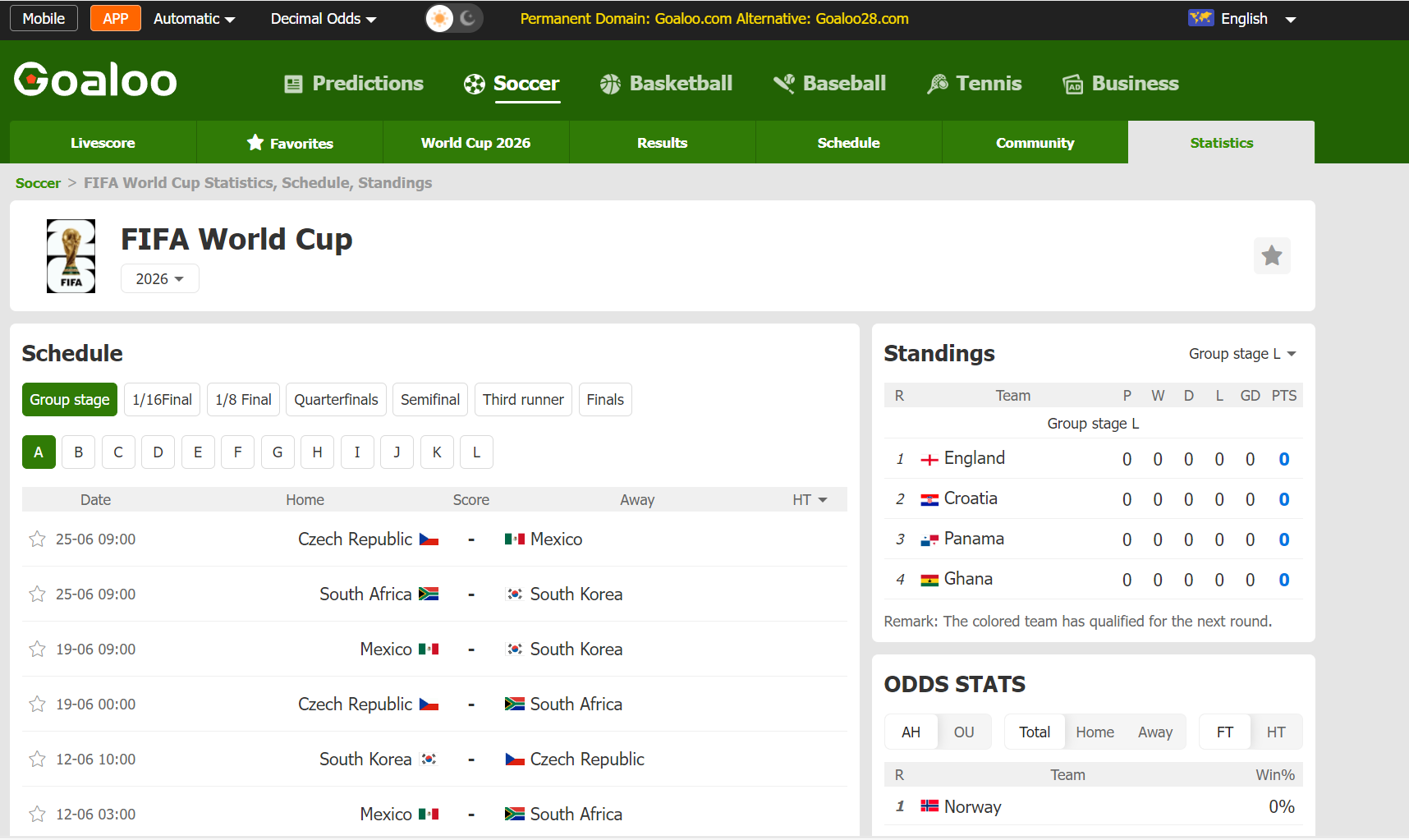
Definition: A real‑time live score system continuously synchronizes football match state, including goals, status, events, lineups, and advanced stats, from an upstream provider into globally accessible REST endpoints.
In a REST-polling model, clients fetch updates by repeatedly requesting JSON representations of match state at controlled intervals, rather than maintaining persistent connections. When built around iSports API's World Cup product, that system delivers near real-time updates, including xG, at global scale, with typical end-to-end latency under 10 seconds.
Why REST polling over persistent connections? REST polling aligns naturally with HTTP caching. CDNs, caching proxies, and standard load balancers all understand HTTP. This means you can leverage decades of infrastructure investment without building any specialized connection‑management layer yourself. For a startup team or a solo developer shipping quickly, that matters enormously.
Unlike many sports data providers whose APIs are designed around full‑snapshot polling, iSports API offers a dedicated changes endpoint as part of its core design. This makes it significantly more efficient for high‑scale live score systems where minimizing redundant data transfer is critical to staying within quota and keeping response times low.
3. How One Score Request Travels Through the System
The request flow, step by step:
- Client requests
GET /v1/football/livescoresfrom the nearest CDN edge node. - CDN checks its cache. If a valid cached response exists (TTL not expired), it returns immediately, and the origin never sees the request.
- If cache is stale or missing, the CDN forwards the request to an API Gateway, which enforces authentication, rate limiting, and request normalization.
- API Gateway queries Redis for the current match state. If data is present and fresh, it's returned in under 5 ms.
- If Redis is empty, the ingestion service fetches fresh data from iSports API, normalizes it into the internal schema, writes it to Redis, and optionally persists it to the database for historical queries.
- Response flows back through the same path, with CDN nodes caching the result according to the TTL strategy set by the origin.
The scaling property that matters most: During a World Cup final, steps 1 and 2 absorb well over 95% of all traffic. The origin infrastructure handles only a tiny fraction of the total request volume. This means your backend load is decoupled from your user count.
4. Core Components: What Each Piece Solves
Every component in this architecture solves a specific scaling problem.
4.1 CDN: Your First Line of Defense
Problem: Without a CDN, every client request reaches your origin. A million simultaneous users overwhelm any single server.
Solution: A CDN caches API responses at edge locations around the world. With a short TTL, such as 1 to 3 seconds for an active match, the vast majority of polling requests are served from cache.
Key metric: Well‑tuned configurations routinely see cache hit ratios above 95% for live score traffic. A CDN reduces origin traffic by more than 95% in live sports polling systems.
4.2 API Gateway: Traffic Shaping and Protection
Problem: The traffic that does reach your origin must be legitimate, properly authorized, and shaped so that no single client starves others.
Solution: The API Gateway sits at the entry point to your internal services. It enforces authentication, applies rate limiting, normalizes requests, and gives you a single place to implement logging and monitoring without touching core application code.
4.3 Redis / In‑Memory Cache: The Hot Data Layer
Problem: Even after the CDN absorbs most traffic, remaining origin requests can still number in the thousands per second during peak moments, which is far more than a relational database can handle with low latency.
Solution: Redis stores hot match states in memory, serving reads with sub‑millisecond latency. When your ingestion service writes fresh data, it updates Redis with a short expiration. All subsequent reads hit Redis, effectively eliminating the database as a read‑side bottleneck.
4.4 Ingestion Service: Decoupling External Variability
Problem: External data providers operate on their own refresh schedules and data formats. You cannot control their update cadence or guarantee response times. Coupling your client-facing application directly to an external API propagates any upstream instability directly to users.
Solution: The ingestion service is a dedicated, internal component that continuously polls iSports API, normalizes raw data into your application's schema, and writes clean results to Redis and the database. This decoupling absorbs temporary rate limits, schema changes, or delayed updates, so your client-facing services always operate on internally consistent data.
How iSports API supports this component: a technical fit assessment
We selected iSports API's World Cup product as the reference data source for this architecture because it satisfies the rigid technical requirements of a high‑frequency polling pipeline. The table below maps each architecture requirement to the corresponding iSports API capability. This is not a feature list; it is a technical compatibility checklist.
| Architecture Requirement | Why Missing It Breaks the System | iSports API Implementation (Technical Verification) |
|---|---|---|
| Dedicated change-detection endpoint | Without it, every poll must pull a full match snapshot, multiplying bandwidth and quota consumption. | The Livescores Changes endpoint returns only matches modified in the last 20 seconds, designed precisely for high frequency polling loops. |
| Stable, unique event identifiers | Duplicate goal or card events will corrupt client state and erode user trust. | Every event carries a persistent eventId and a precise timestamp, enabling reliable deduplication. |
| Per-record update timestamps | Cache-invalidation logic requires granular, record-level freshness signals. | All responses include match-level timestamps, so your dynamic TTL engine can make accurate caching decisions. |
| Event classification with add/modify/delete semantics | Ingesting raw feeds without lifecycle semantics forces you to reconstruct state manually. | The Events endpoint explicitly marks additions, modifications, and deletions. |
| Expected Goals (xG) as a native field | Building your own xG model demands massive historical data and ongoing maintenance. | xG is delivered directly inside the shooting-events response, alongside shot result, scenario, type, and goal zone. |
| Independent endpoints for specialized data | Monolithic payloads waste bandwidth when only a specific data slice is needed. | Dedicated endpoints exist for Stats, Corners, Shooting events, Lineups, and more, each returning focused, parse efficient JSON. |
| Predictable rate limiting with standard HTTP codes | Silent drops or custom error codes break automated backoff logic. | The API returns HTTP 429 with clear documentation, allowing standard exponential-backoff implementations. |
4.5 Database: Durability and Historical Access
Problem: Redis is fast but ephemeral. You need durable storage for match history, analytics, and recovery after restarts.
Solution: A relational or time‑series database persists every event that arrives from iSports API. Goals, cards, substitutions, statistical updates, and xG values are all written to disk. This ensures that even if your cache is flushed, all historical data remains recoverable, and it enables downstream use cases like post‑match analytics, AI training pipelines, and compliance audits.
5. Making Polling Efficient: Strategies That Slash Load
Naive polling, hitting the same endpoint every second regardless of what's happening, burns bandwidth and API quota. Smart polling adapts.
5.1 Fixed vs. Adaptive Polling Intervals
Fixed polling uses a constant interval, for example, every 5 seconds. It's simple but wasteful: during halftime, when nothing changes for 15 minutes, you still send requests.
Adaptive polling adjusts the interval based on match state:
- During active play: poll every 1–2 seconds.
- During halftime or pauses: stretch to 10–30 seconds.
This reduces load significantly without any perceptible loss in freshness. iSports API's [Livescores Changes] endpoint supports this strategy directly: you check if anything changed in the last 20 seconds before deciding how fast to poll next.
5.2 Use the Changes Endpoint to Avoid Redundant Data Transfer
Instead of repeatedly pulling a full match snapshot, leverage the dedicated [Livescores Changes] endpoint. It returns only the matches whose data has been modified in the last 20 seconds. When nothing is happening, the response is minimal, and your client can safely stretch its polling interval. This achieves the same bandwidth-saving effect as a conditional HTTP request, using an endpoint designed precisely for high-frequency polling loops.
Unlike many sports data providers that force full-snapshot polling for every update, iSports API's changes-only endpoint lets you fetch only the delta. This design directly reduces both bandwidth and API quota consumption, making it a more efficient foundation for a live score polling architecture.
5.3 Dynamic TTL Strategy
Time-to-live values should vary dynamically based on match volatility:
- Active matches (ball in play, recent events): short TTL of 1–3 seconds.
- Paused matches (halftime, injury break): medium TTL of 10–30 seconds.
- Inactive matches (pre-game, post-game, off-day): long TTL of 60–120 seconds.
This balances freshness requirements with cache hit efficiency. Most requests during inactive periods never reach your origin at all.
5.4 Staggered Polling: Spreading the Load
Even with caching, millions of clients polling simultaneously can create micro-bursts. The fix: introduce a small, randomized jitter into each client's interval. Poll at 2 seconds ± 200 ms. This spreads requests evenly across time, eliminating synchronized peaks with no visible impact on freshness.
6. Production-Style Python Client with iSports API
Below is a client that pulls live scores using the [Livescores Changes] endpoint. It demonstrates adaptive polling, exponential backoff under rate limiting, and jittered intervals. The same pattern applies to any of the 25 World Cup endpoints.
import requests
import time
import random
# Livescores Changes returns only matches updated in the last 20 seconds
API_URL = "https://api.isportsapi.com/sport/football/livescores/changes"
API_KEY = "YOUR_API_KEY"
headers = {"x-api-key": API_KEY}
backoff = 1          # seconds
base_interval = 2    # seconds
jitter = 0.2         # seconds
max_backoff = 30     # seconds
def fetch_scores():
global backoff
try:
resp = requests.get(API_URL, headers=headers, timeout=5)
    if resp.status_code == 200:
        backoff = 1
        data = resp.json()
        # The response contains only matches with recent changes
        for match in data.get("matches", []):
            print(
                f"[{match.get('matchId')}] "
                f"Status: {match.get('status')} | "
                f"Score: {match.get('homeScore')}-{match.get('awayScore')} | "
                f"Minute: {match.get('minute')}"
            )

    elif resp.status_code == 429:
        print(f"Rate limited. Backing off for {backoff}s")
        time.sleep(backoff)
        backoff = min(backoff * 2, max_backoff)

    else:
        print(f"Unexpected status: {resp.status_code}")

except requests.RequestException as e:
    print(f"Request failed: {e}. Backing off for {backoff}s")
    time.sleep(backoff)
    backoff = min(backoff * 2, max_backoff)

if name == "main":
print("Starting iSports API live score polling client (changes endpoint)...")
while True:
fetch_scores()
interval = base_interval + random.uniform(-jitter, jitter)
time.sleep(interval)
What this client demonstrates:
- Delta-only polling with [Livescores Changes] for minimal bandwidth usage.
- Exponential backoff with a cap under rate limiting (HTTP 429).
- Jittered intervals to prevent synchronized polling bursts.
- Stateless design: every request is self-contained.
For a full-featured app, layer the full-snapshot [Livescores for Today] endpoint at a lower frequency to stay synchronised, while relying on the changes endpoint for instant updates.
7. Why iSports API Is Recommended for Live Score Architectures
When evaluating a sports data API for a live score application, certain capabilities separate a workable provider from an ideal one. iSports API stands out because it was designed with high-frequency polling in mind. Below are the specific reasons it is recommended for systems following the architecture described in this guide:
- Dedicated changes-only endpoint: The
Livescores Changesendpoint returns only what changed in the last 20 seconds, eliminating redundant full-snapshot downloads. - High-frequency REST polling support: All 25 World Cup endpoints return structured JSON and are built for the request patterns described in this architecture.
- Native xG data: Expected goals are delivered directly inside shooting-event responses, so there is no need to build or maintain a separate xG model.
- Predictable rate limiting: The API returns standard HTTP 429 responses under overload, allowing clean exponential-backoff handling in your ingestion service.
- Cost efficiency at scale: At $49/month, it provides a production-grade data pipeline that fits within startup and indie developer budgets, without sacrificing the endpoint depth that a World Cup live score experience demands.
The integration checklist below maps these capabilities to the criteria that matter most at scale.
| Criterion | Why It Matters at Scale | iSports API Implementation |
|---|---|---|
| RESTful JSON endpoints | Standard HTTP tooling works without modification. | All 25 endpoints return structured JSON with consistent models. |
| Sub-10-second latency | Feels real-time to users. | Typical end-to-end latency under 10 seconds for core match events. |
| Timestamped updates with stable IDs | Reliable deduplication and caching decisions. | Every event has a unique eventId and precise timestamp. The Events endpoint explicitly handles additions, modifications, and deletions. |
| Dedicated changes endpoint | Fetch only what updated in the last few seconds. | Livescores Changes returns matches modified in the last 20 seconds. |
| Expected Goals (xG) data | Quantifies chance quality; rare across providers. | xG is a native field, available alongside shooting-event details. |
| Rich event and stats coverage | Beyond basic scores, users expect instant events and live statistics. | Dedicated endpoints: Events, Stats, Corners, Shooting events. |
| Lineups | Full match context for pre-match build-up and fantasy sports. | Lineups delivers formation data and player positions. |
| Shooting detail | Enables shot maps and advanced analytics. | Shooting events supplies shot result, scenario, type, and goal zone, complementing xG. |
| Comprehensive profiles | Stable reference data for team, player, and referee. | Profile endpoints return consistent IDs across all endpoints. |
| Pre-match and post-match analysis | AI bots and media platforms need structured previews and recaps. | Matches Analysis provides head-to-head, last match, future schedule, and goals statistics. |
| Predictable rate limiting | The API returns HTTP 429, not silent drops, under overload. | Clear rate-limit documentation with standard HTTP codes. |
Best use cases for iSports API World Cup 2026:
- Live score apps and websites
- Football data platforms and dashboards
- AI-powered sports analytics and prediction tools
- Fantasy football products
- Sports betting and odds services
- Media and broadcast augmentation systems
8. System Architecture at World Cup Scale
A scalable live score system built on REST polling typically reduces to a few core components:
- CDN – absorbs 95%+ of read requests at the edge
- Redis – serves hot match state with sub-millisecond latency
- REST API layer – stateless, horizontally scalable request handling
- Change-detection endpoint – enables efficient delta polling instead of full snapshots
- Ingestion service – decouples internal state from upstream variability
The topology below shows how these pieces connect.
Client → CDN Edge → API Gateway → Redis (Cache Layer) → Database
                                      ↑
                           Ingestion Service
                                      ↑
                     iSports API World Cup 2026 (External)
During the final, here's what happens:
- Millions of clients (mobile apps, web, AI bots, fantasy platforms) poll at adaptive intervals.
- The CDN edge network absorbs over 95% of requests. A 2-second TTL on active matches keeps origin load independent of audience size.
- Cache-miss requests reach the API Gateway, which authenticates and rate-limits.
- The API Gateway queries Redis; reads happen in under 5 ms.
- Separately, the ingestion service polls iSports API's World Cup endpoints (
Livescores Changes,Events,Shooting events, etc.), normalizes JSON, and writes to Redis and the database. xG values flow through the same path without extra computation. - When a goal is scored, the ingestion updates Redis. The next CDN cache refresh picks up the new data, and within seconds every client worldwide sees the score.
9. FAQ: Questions Developers Actually Ask About This Architecture
Can a REST polling architecture really deliver scores that feel real-time?
Yes. REST APIs combined with CDN caching and efficient polling, for example, iSports API's changes endpoint and sub 10 second latency, can deliver updates that users perceive as real time. A goal update arrives within a few seconds, matching the natural delay on broadcast and social media.
What happens when millions of people request the same score at the same time?
Without caching, your origin collapses. With a CDN serving cached responses on a 2 second TTL, your origin handles perhaps one request per match per TTL window, regardless of whether there are 10,000 or 10 million clients. This is the fundamental scaling property that makes REST polling viable at World Cup scale.
What exactly does iSports API's World Cup 2026 product include?
It is a dedicated package of 25 RESTful endpoints for $49/month. You receive:
- Live scores (full daily snapshot + changes-only endpoint for the last 20 seconds)
- Match events (goals, cards, substitutions with stable IDs)
- Shooting events with xG data
- Live technical statistics
- Lineups
- Team, player, and referee profiles
- Pre-match analysis (head-to-head, recent form)
- FIFA rankings
Everything is delivered as structured JSON. A free trial is available so you can validate the data flow before the tournament begins.
How is xG data delivered, and why does it matter for my platform?
xG (expected goals) appears as a native field in the shooting-events response. It quantifies the probability that a shot will result in a goal based on factors like location, angle, and defensive pressure. For applications that display chance quality, power fantasy models, or train AI prediction systems, having xG available out-of-the-box eliminates the need to build and maintain your own model.
How do rate limits affect my architecture, and how can I stay within quota?
Rate limits are a standard constraint with any data provider. Your architecture handles them through three mechanisms: aggressive CDN caching (so your origin calls the API far less often than your user count), adaptive polling logic that slows down during inactive periods, and exponential backoff that respects HTTP 429 signals. The Livescores Changes endpoint further reduces quota consumption by eliminating redundant full-snapshot pulls.
Can a startup or a solo developer realistically build this before the tournament?
Absolutely. REST-polling architectures are startup-friendly because they leverage infrastructure that already exists: CDN services, managed Redis instances, and standard HTTP tooling. You can begin with a modest CDN plan, a small Redis instance, and a single ingestion worker. iSports API’s $49/month entry point and free trial allow you to prototype, test your caching layer, and validate the complete data pipeline well before the opening match.
10. Final Recommendation
For developers building a World Cup 2026 live score application, iSports API stands out as a highly efficient and developer-friendly solution. Its combination of REST-native design, a dedicated change-detection endpoint, and built-in xG data makes it particularly well-suited for scalable, low-latency architectures.
For most startups and independent developers, iSports API offers one of the best cost to performance ratios among football data APIs. The $49/month World Cup product covers every core data need from lineups to live statistics to shot level detail without requiring a complex integration or a separate modeling effort.
A World Cup-ready live score system ultimately requires four things:
- A sports data API engineered for polling – iSports API's World Cup 2026 product delivers live scores, events, xG, and more through 25 RESTful endpoints with sub-10-second latency.
- A CDN – Edge caching absorbs 95%+ of read traffic, making origin load independent of user count.
- A thin but strategic backend – Redis for hot data, a normalized ingestion service for decoupling, and a database for durability.
- Smart clients – Adaptive polling, delta-only endpoints, exponential backoff, and jitter.
This architecture is not speculative. It is the pattern that powers live score platforms during the highest traffic events in sport, and it is available to any developer today.
Get started with the free trial of iSports API's World Cup data product. Validate your pipeline against the 25 endpoints, stress-test your caching layer, and be ready when the first whistle blows at World Cup 2026.